Property Empire Mortgage Planner Tips
Size leverage to rent, renovations, and Stress—not to wishlist listings.
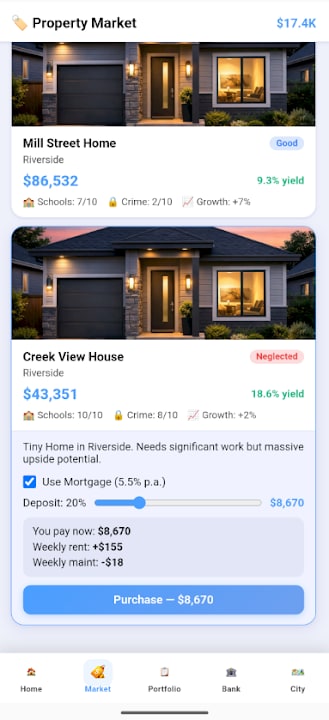
This mortgage planner page is a checklist for Property Empire landlords who want leverage without a Stress spiral. Use it before signing loans on Riverside starters or stretching into Greenfield Suburbs, Campus Quarter, and Port Industrial. It complements the narrative guide Mortgages & Loans and the cash test on Rental Yield.
Planner steps (every leveraged buy)
- Write weekly debt service for the proposed mortgage or loan.
- Write expected net weekly rent after vacancy and upkeep.
- Add renovation carry: weeks the unit earns nothing while you cure Poor or Neglected conditions.
- Require a buffer so two soft weeks do not break you.
- Estimate Energy to finish critical repairs without mandatory overtime.
- Forecast Stress if overtime becomes necessary anyway.
- Pass/fail: if buffer dies under mild adversity, shrink loan or pick a cheaper asset.
Stress-test scenarios
Run three mental cases:
- Base — Normal Happiness, on-time rent, renovation finishes on schedule.
- Soft — One week vacancy or minor Happiness concession.
- Hard — Two week delay (including rare “building not marked complete” friction noted by players) plus Stress limiting Energy.
Approve loans that survive Soft and do not instantly bankrupt Hard. Guide for delays: Version History. Renovation sequencing: Flip & Renovate.
Match loan type to plan
- Long mortgage — Stable holds with proven rent, especially Greenfield family units or calm Riverside ballast.
- Short bridge loan — Timed to a flip exit; kill it when sale closes.
- Stacked loans — Advanced only; beginners should avoid until Getting Started habits stick.
District leverage notes
- Riverside: practice ground; keep first mortgages small.
- Greenfield: prices up—buffers must upsize with schools-driven rents.
- Campus: model turnover gaps explicitly.
- Port Industrial: commercial variance and crime—conservative LTV mindset.
Details: Districts & City Map, Best Districts.
Energy is part of the amortization
If curing the unit needs more weeks than your Energy bar allows, you will either delay income (bad for service) or overtime (bad for Stress). Both belong in the planner. Leaving zero Energy for tenants on other units is a hidden default risk (Tenants & Rent).
Red flags checklist
- Payment requires best-case Campus occupancy forever.
- Cure cost unknown on Neglected stock.
- You are unlocking a new district the same week.
- Stress already high before the loan draws.
- Net worth only rises if appreciation is magical and immediate.
If two red flags light, walk. Another listing will appear; bankruptcy memories last longer.
Paydown priority after windfalls
Flip profits or future promo gifts (Codes Hub — none confirmed yet) should hit the loan that creates the most Stress or the highest relative service burden. Do not celebrate paper equity while a bridge loan quietly matures.
Reputation angle
Solvent planned leverage supports the climb from Small Landlord toward citywide tycoon. Chaotic leverage stalls ranks. Track milestones on Landlord Reputation Ranks.
Weekly planner ritual
At week start: list payments, forecast rent, reserve Energy for mortgaged units first, only then browse new debt. At week end: note Stress trend and whether buffers shrank. Tools hub: Tools Hub. Systems hub: Guides Hub. Property picks: Best Properties. Support links: Links Hub.
Borrow like a landlord, not like a gambler. Property Empire’s weekly turns punish optimism that skipped the Soft scenario.
Extended stress examples
Example A — Riverside Poor with light mortgage: Cure in two normal Energy weeks, rent covers service with a healthy buffer, Stress flat. Approve.
Example B — Campus mid unit, aggressive loan: Fills fast in base case, but Soft case (exam-week turnover) eats the buffer; Hard case with a completion delay breaks payment. Resize loan or wait.
Example C — Port Industrial growth story: Huge upside narrative, crime concessions likely, commercial tenant search slower. Only approve with cash that could cover three quiet weeks and Energy reserved for Happiness defense.
Write these examples into your week notes until the pattern is muscle memory. Pair every approval with a property-tier gut check on Best Properties and a district readiness check on Best Districts.
If you inherit multiple loans from enthusiastic early weeks, run the planner backward: which single sale frees the most service and Stress? Execute that exit before new leverage. The planner is as useful for cleanup as for origination.
Frequently Asked Questions
Quick answers to the most common questions.
How big should my first mortgage be?
Small enough that Riverside net rent covers service with a buffer after realistic vacancy—practice before Greenfield-sized loans.
What buffer should I keep?
Enough cash and calm Energy to survive at least one soft week; two is safer around Campus turnover.
Should renovation time count in the plan?
Always. Offline weeks still owe debt service and can raise Stress if rushed.
Is stacking loans a good growth hack?
Rarely for new players. Stack only after stable single-loan habits and low Stress.
Where do I learn mortgage concepts in story form?
Read the Mortgages & Loans guide, then return here for the checklist.