Property Empire Rental Yield Guide
Estimate real returns after vacancy, upkeep, and district metrics.
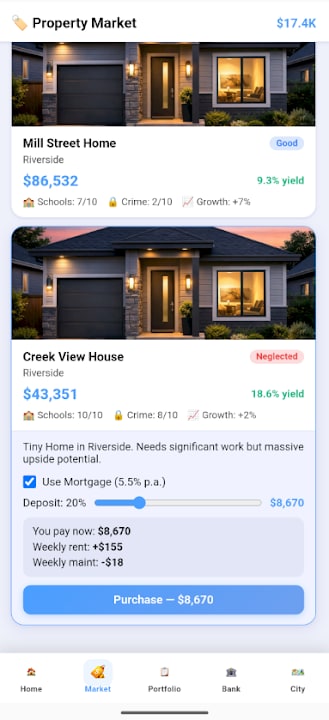
Rental yield tells you whether a Property Empire hold deserves cash and Energy—or whether you should flip and move on. This guide shows a practical weekly method for the Android tycoon: start from asking rent, subtract vacancy and upkeep, compare to price basis and mortgage service, then adjust for district metrics like schools, crime, and growth.
Simple weekly yield frame
- Gross weekly rent you can actually achieve at healthy Happiness—not the fantasy max.
- Subtract vacancy allowance (higher in Campus Quarter turnover; lower in sticky Greenfield families when schools are strong).
- Subtract upkeep / landlord Energy monetized (repairs, concessions, ad downtime if relevant to your pacing).
- Arrive at net weekly rent.
- Divide by total basis (purchase + renovations + closing friction) and compare to alternatives.
If net weekly rent cannot cover weekly mortgage service with a buffer, the yield story failed—see Mortgage Planner Tips and Mortgages & Loans.
Yield versus appreciation
High appreciation districts can justify thinner current yield if you plan a flip exit after renovations (Flip & Renovate). Pure landlords should demand clearer cash yield. Many strong portfolios mix: Riverside or Greenfield cash ballast plus selective appreciation plays.
Paper net worth from appraisals feels good; unpaid Stress from thin yield does not. Property Empire is single-player—cash keeps you alive.
District adjustments
- Riverside — Modest rents; yield wins come from low basis and Poor/Neglected discounts cured cheaply.
- Greenfield Suburbs — School ratings can support higher sustainable rent; underwrite family stability.
- Campus Quarter — High demand helps gross rent; raise vacancy allowance for churn.
- Port Industrial — Commercial rents follow growth and crime; do not paste residential assumptions.
Map context: Districts & City Map, ranks: Best Districts, unit types: Best Properties.
Happiness as a yield input
If you must slash rent or spend heavy Energy to keep Happiness from collapsing, your net yield is lower than the listing implies. Model a Happiness maintenance cost. Guide: Tenants & Rent.
Worked mental example (illustrative)
Suppose a Riverside Poor unit costs a modest sum plus two Energy-heavy repair weeks. Achievable rent is steady, vacancy rare, upkeep light after cure. Net yield can beat a full-price pretty listing nearby. Now picture a Campus “luxury” unit at high price with seasonal empties: gross rent dazzles, net yield disappoints. Same game, different math.
When low yield is still acceptable
- Bridging toward a reputation milestone (Landlord Reputation Ranks).
- Parking cash in a calm unit during a Stress spike.
- Strategic hold while appreciation catalyzes after a district growth tick.
Even then, know the cost. Do not pretend a vanity hold is a yield king.
Workflow before every rental buy
- Read live metrics: yield hints, appreciation, schools, crime, growth.
- Estimate cure Energy if condition is Poor or Neglected.
- Compute net weekly rent with vacancy.
- Compare to debt service and to flip IRR gut feel.
- Check portfolio Energy—can you still serve existing tenants?
- Bid only if S/A on your personal sheet.
Beginners: Getting Started. Broader systems: Guides Hub. Tools overview: Tools Hub.
Patch and bug footnotes
If a renovation fails to show complete, your online date slips and yield starts later—extend underwriting weeks (Version History). Recalibrate after balance patches on Updates.
Codes
Do not underwrite assuming promo gifts (Codes Hub). Official app and support: Links Hub.
Yield is a habit. Landlords who estimate net rent honestly unlock districts slower—and bankruptcies even slower.
Longer underwriting notes
Treat every listing tooltip as marketing until you pressure-test it. Ask what rent looks like if Happiness is merely “okay,” not perfect. Ask what vacancy looks like if you also run a flip two blocks away and Energy is scarce. Ask whether crime or weak schools force concessions that never appear on the card.
When comparing two holds, normalize to the same cash tied up. A cheaper Riverside unit at modest rent can beat a pricey Campus unit on yield per dollar even when Campus wins on rent per door. That per-dollar view matters when mortgages compete for the same buffer—see Mortgages & Loans.
Appreciation should enter as a separate column, not a vague hope. If you need appreciation to justify a thin yield, write the exit week and the Energy still required before that exit. If you cannot name them, you are not underwriting—you are wishing.
Finally, revisit yield after each renovation stage. Partial cures that make a unit barely rentable may temporarily show weak yield; finishing the plan can restore it. Stopping mid-Neglected because you chased another deal often locks in the worst of both worlds: low yield and unfinished Stress.
Frequently Asked Questions
Quick answers to the most common questions.
What is a quick definition of rental yield here?
Net rent after vacancy and upkeep relative to what you invested—used to judge holds versus flips.
Should I use maximum possible rent in the formula?
No. Use rent compatible with healthy Happiness and realistic local demand.
Which district needs the highest vacancy allowance?
Often Campus Quarter because of turnover and seasonal gaps—adjust to your experience.
Can strong appreciation replace yield?
Partially for planned flips. Pure cash-flow landlords should still demand solid net rent.
How does crime affect yield math?
Crime can force concessions, higher vacancy, or Happiness spends—lower net yield unless price compensates.